We’ve recently invested £1.2m in new equipment. Here’s what we bought, what it solves, and what it means for the electronics we build for you.
Consistent placement — every board, every run Hanwha SM482PLUS Surface Mount Machine
The challenge with high-volume or complex assemblies isn’t hitting the right placement accuracy once. It’s maintaining it across an entire run, across different component types, across boards that mix fine-pitch passives with large ICs.
The Hanwha SM482PLUS addresses this through on-the-fly vision recognition — identifying and calibrating each component in motion, compensating for pickup variation in real time. A polygon recognition algorithm handles irregular component shapes without manual reprogramming between jobs.
The first board off the line and the last one are built to the same standard. That’s what consistent placement actually looks like.
Solder joints that hold up in service Heller 1810 MK7 10-Zone Reflow Oven
Uneven heat is the hidden risk in reflow. A high temperature delta across a board means some areas run hotter than others — introducing stress, increasing voids, and damaging heat-sensitive components in ways that often don’t surface immediately.
The Heller 1810 MK7 gives us ten independently controlled zones, so we can build a thermal profile specific to your assembly. Temperature rise, soak time, cooling slope all controlled precisely. Cooling rates above 6°C per second when the design demands it, with strong thermal separation between zones to keep heat where it should be.
The result is higher first-pass yields and solder joints that perform reliably in service, not just at inspection.
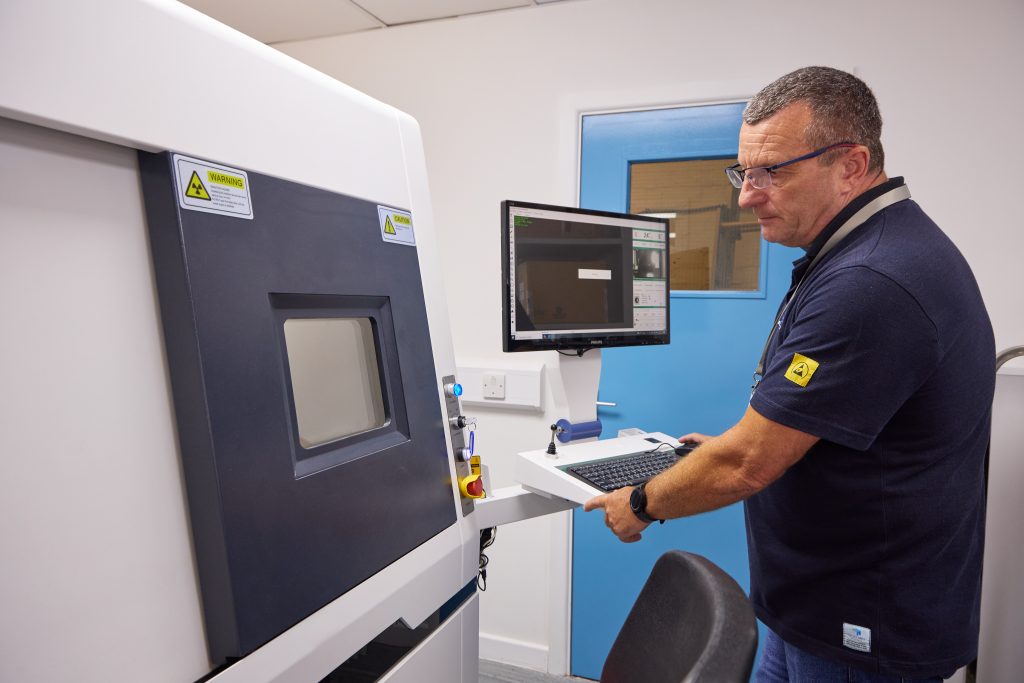
Inspection that sees through the board Unicomp AX8200max X-Ray Machine
BGA packages, QFNs and other bottom-terminated components are soldered on the underside. You cannot verify joint quality with optical inspection alone, you need to look through the board.
The Unicomp AX8200max does exactly that, with a 5µm focus spot and oblique angle inspection up to ±60°, giving us a clear view of joint shape and void formation that a top-down approach would miss entirely.
It also gives us a robust check against counterfeit components, verifying internal geometry, die size and bond wire routing, all of which deviate from spec in fakes. It’s a real and growing supply chain risk. This is how we address it.
3D measurement, not just 2D inspection Mirtec MV-3 OMNI 3D AOI
Co-planarity errors, lifted leads and insufficient solder are three-dimensional problems. A 2D AOI system gives you a projection; a 3D system actually measures them.
The Mirtec MV-3 OMNI uses Moiré technology to build a full height map of every assembly, with a 15-megapixel camera and angled side-viewer capturing what a top-down view misses. Eight-phase coaxial lighting reduces false calls on reflective surfaces saving time that would otherwise be spent investigating defects that don’t exist.
We run every board through the AOI system. Every board, not just a sample.
The team behind the technology
Equipment is only part of the picture. Last year we invested £35k in staff development, putting our entire manufacturing team through IPC certification — A-610, J-STD-001 and 7711/7721. These are the industry benchmarks for assembly quality, soldering standards and rework.
Most manufacturers certify one or two key people. We certify everyone who touches your product, trained and examined by our own internal IPC trainer. The standard doesn’t drop depending on who’s on shift.
Built to remove the variables that cause failures
Across new equipment and a fully certified team, what we’ve built is a manufacturing environment where the variables that cause failures — placement drift, thermal inconsistency, hidden solder defects — are systematically removed.
If you’d like to see the facility or talk through what this means for your next project, we’d be glad to show you around.
Electrica Ltd designs, develops and manufactures performance-critical and complex electronics in-house at our UK facility. Get in touch to discuss your project.